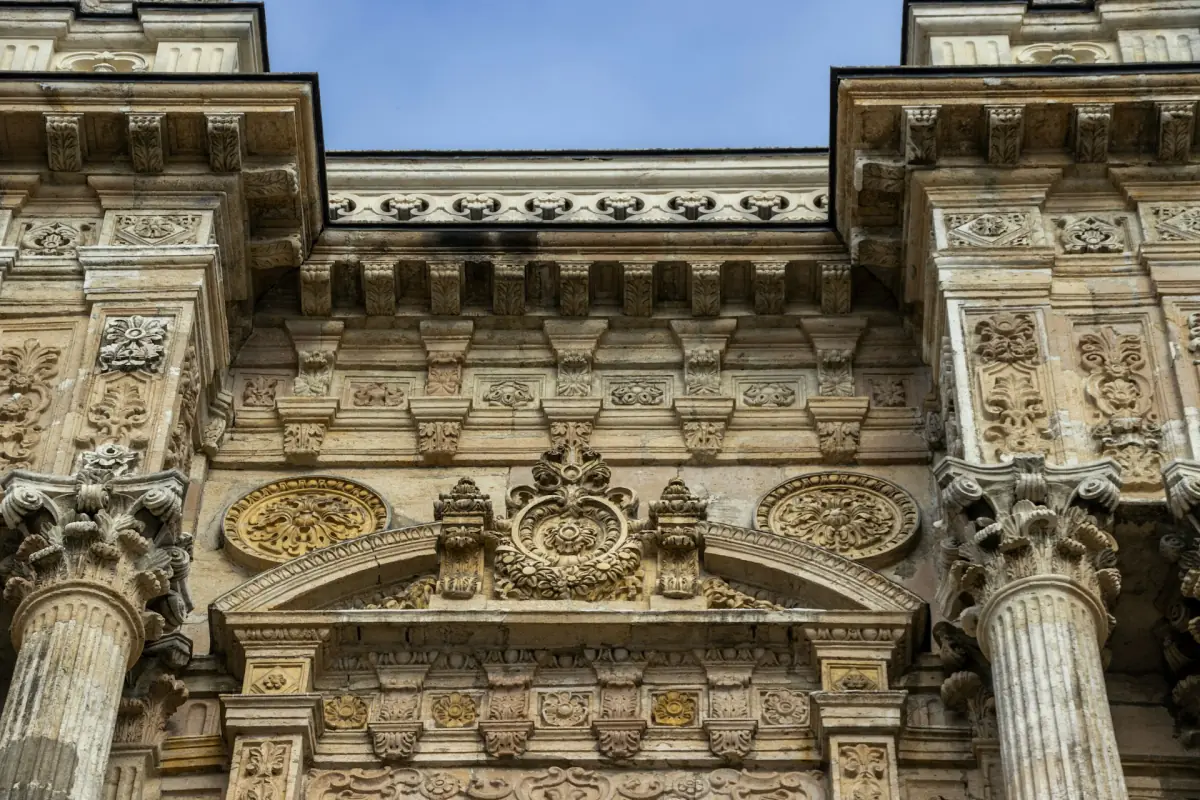
Understanding Dolmabahçe Palace architecture
Dolmabahçe Palace architecture is easier to understand when the rooms are read as parts of a working residence. The Selamlık, also called Mabeyn, served administration; the Harem was the family area. Between them stands the Ceremonial Hall, the Muayede Salonu. This arrangement gives a useful framework for looking at the building: government, family life and ceremony occupy distinct places within the palace rather than forming an undifferentiated collection of decorated rooms.
The palace was commissioned by Sultan Abdülmecid, with construction beginning in 1843 and the opening in 1856. Its setting on the Bosphorus is another part of the experience, but the waterfront elevation tells only part of the story. Pair an interior visit with an understanding of the room plan before adding a Bosphorus cruise. From the water, attention turns to the exterior; inside, the relationship between spaces becomes the central subject.

Crystal Staircase and Ceremonial Hall
The Crystal Staircase is among the palace features highlighted by the state educational visitor notes. Approach it as an architectural space as well as a named highlight. The accompanying image shows the glass roof and columns of its atrium, providing a different perspective from the carved exterior shown at the beginning of this guide. An existing interior photograph should not be used as permission to take photographs during your own visit; follow current signs and staff instructions.
The Ceremonial Hall provides the link between the administrative and family sections. Keeping that position in mind helps give the hall meaning beyond its decoration. Look at how your visit moves between formal state space and the domestic part of the residence. For the events and changes of use behind these rooms, continue with the palace history, rather than expecting an architectural highlight to explain the whole chronology.
Our picks: explore the palace
Our take: Choose the Harem ticket if that section matters to you. The other entry options include audio guides, but do not separately confirm Harem access.
Hand-picked tours, booked through GetYourGuide and Viator. Prices are indicative starting prices in euros (as of October 2026). Tap a tour for live availability and the current price in your currency.

Palace entry and audio guide
- Dolmabahçe Palace entry tickets
- Audio guide
Use the audio guide to explore the palace at your own pace.
Check availability →
Museum entry with audio
- Audio guide available in 25 languages
- Skip the Line Entry Ticket
This entry option includes an audio guide; Harem access is not separately confirmed.
Check availability →
Palace and Harem audio visit
- Audio guide in 25 different languages
- Skip-the-line-entry ticket
- Harem Section
Explore independently without a live guide; the entrance location depends on the option booked.
Check availability →Entry options for the palace interior
Compare regular palace admission and audio visits, including an option with explicit Harem access.
The palace interior: 285 rooms, 44 halls and six hamams
The state educational description gives 285 rooms, 44 halls and six hamams for Dolmabahçe. These are figures for the building, not a checklist of rooms promised by every admission product. Use them to grasp the scale and variety of the palace. A visit focused on the Selamlık and Harem is about understanding the different functions of those sections, rather than counting how many spaces can be crossed in a fixed time.
For a Dolmabahçe Palace interior visit, choose the included sections with care. The palace and Harem audio option includes entry to both sections and an audio guide, without a live guide. Other entry and audio options have their own admission wording. If the Harem is essential to your day, select explicit Harem coverage. Our ticket comparison explains that distinction and the shared palace ticket without turning this architecture page into a second price list.
Balyan and the language of historic buildings
The palace administration names Karabet Balyan, Ohannes Serveryan, Nikoğos Balyan and James William Smith in its account of the architects and construction leadership. The architectural description combines a traditional Ottoman plan with Baroque, Rococo and Neoclassical design and decoration. That combination gives you a practical way of looking: consider the use and position of a room, then examine its decorative treatment. The plan and the ornament answer different questions about the same building.
The entry options on this page are visits to the historic building, including audio formats. Choose them for access and interpretation of the palace, and use a guided palace programme if live explanation is the service you want. Keep those services distinct when comparing your day. A regular admission with audio is a useful way to approach the building without presenting it as a specialist architectural seminar. For a guide arranged for your own group, see the page on private Dolmabahçe Palace tours.
Painting Museum and art in context
The Painting Museum occupies the former Crown Prince’s apartment and opened as a museum on 22 March 2014. Its administration describes 553 paintings and drawings and 34 thematic galleries, with works from the sixteenth to twentieth centuries. These figures describe the collection and presentation; approach the museum through its themes rather than planning around a promise that every named work will be hanging during a particular visit.
Court painting, Aivazovsky, Abdülmecid Efendi, Osman Hamdi Bey and views of Istanbul are among the subjects listed by the museum. They extend the architectural visit into the visual culture associated with the palace. Art gives another reason to consider the scope of your admission and leave room in your itinerary for more than a façade photograph. The museum’s setting also connects its present use to the former residential functions of the complex.
Mosque and clock tower outside
The clock tower was added in the period of Abdülhamid II. The nearby Dolmabahçe Mosque is also known as Bezm-i Alem Valide Sultan Camii. Historical architectural writing describes its dome above a square main space and its western influenced decoration. Together these exterior reference points widen the architectural context around the palace. Treat an interior mosque visit as a separate access question and follow local instructions, rather than extending a palace admission to every nearby building.


Questions about your visit
Is the Harem part of the architectural visit?
The Harem is the family section of the palace. Choose an option that explicitly includes its admission when it is part of your planned visit.
Are these specialist architecture tours?
The options here are palace admission and audio formats. Live guided programmes are compared on the tours page.
May I take photographs inside?
Follow current photography signs and staff instructions in each area. An interior image in a guide does not establish the rules for your visit.